Trauma-informed
Centres safety, care, and nervous system awareness.
The Empowered Supervisor offers trauma-informed, anti-oppressive education and clinical supervision for counsellors and helping professionals who want to develop confidence, clarity, and skill in their practice.

Centres safety, care, and nervous system awareness.
Challenges systemic barriers and honours diverse identities.
Real-world tools and meaningful reflection.
Supports long-term wellbeing and ethical practice.
A space for connection, meaningful learning, and ethical practice.
Meaningful supervision makes room for uncertainty, reflection, and growth. It supports ethical practice while attending to the person doing the work.
Here, we consider how trauma, identity, power, and social context shape clinical relationships. Together, we build a practice that is compassionate, accountable, and sustainable.
Build your foundation, continue with Advanced Practice & Consultation, or explore feminist approaches, queering supervision, and neurodiversity through our special-topic courses.
Explore our courses →Bring your clinical questions, ethical dilemmas, and professional development goals into a collaborative space for reflection.
Explore supervision →A trauma focused, anti-oppressive exploration of clinical supervision for practitioners developing or deepening their supervisory practice.
The course connects supervision approaches and processes with ethical decision-making, awareness of power, and the realities of sustaining a supervision practice.
View 2027 dates & apply →Each cohort meets for 10 weeks on Fridays, 12–2 p.m. Toronto local time via Zoom. Complete 36 hours of learning: 20 live hours plus 16 hours of asynchronous readings, reflection and assignments.
January 15–March 19, 2027
Early bird: $895 CAD through December 31, 2026.
Regular tuition: $1,095 CAD.
Apply by January 8, 2027.
Apply for Winter ↗April 9–June 11, 2027
Early bird: $895 CAD through March 26, 2027.
Regular tuition: $1,095 CAD.
Apply by April 2, 2027.
Apply for Spring ↗October 8–December 10, 2027
Early bird: $895 CAD through September 24, 2027.
Regular tuition: $1,095 CAD.
Apply by October 1, 2027.
Apply for Fall ↗Attendance: Attendance at at least 8 of the 10 live calls is required, along with completion of the asynchronous learning.
Payment options: Pay in full or request a payment plan on your application. Instalment options and payment deadlines will be provided separately.
Cancellation: Full refund minus a $25 processing fee with at least 48 hours’ notice before your cohort’s first class.
Explore the purpose of supervision, supervisory roles and responsibilities, and the foundations of a collaborative relationship. Consider how safety, accountability, and context shape the work.
Examine supervision models through trauma focused, feminist, anti-oppressive, and postmodern perspectives. Reflect on how your values and experience inform your supervisory approach.
Consider supervision agreements, informed consent, reflective dialogue, feedback, and evaluation. Explore processes that support learning while making expectations and power visible.
Explore ethical dilemmas, boundaries, responsibilities, and the influence of power and identity. Practise thinking through complex situations with care and accountability.
Reflect on professional wellbeing, trauma stewardship, and sustainable practice. Consider the practical boundaries and business decisions involved in offering clinical supervision.
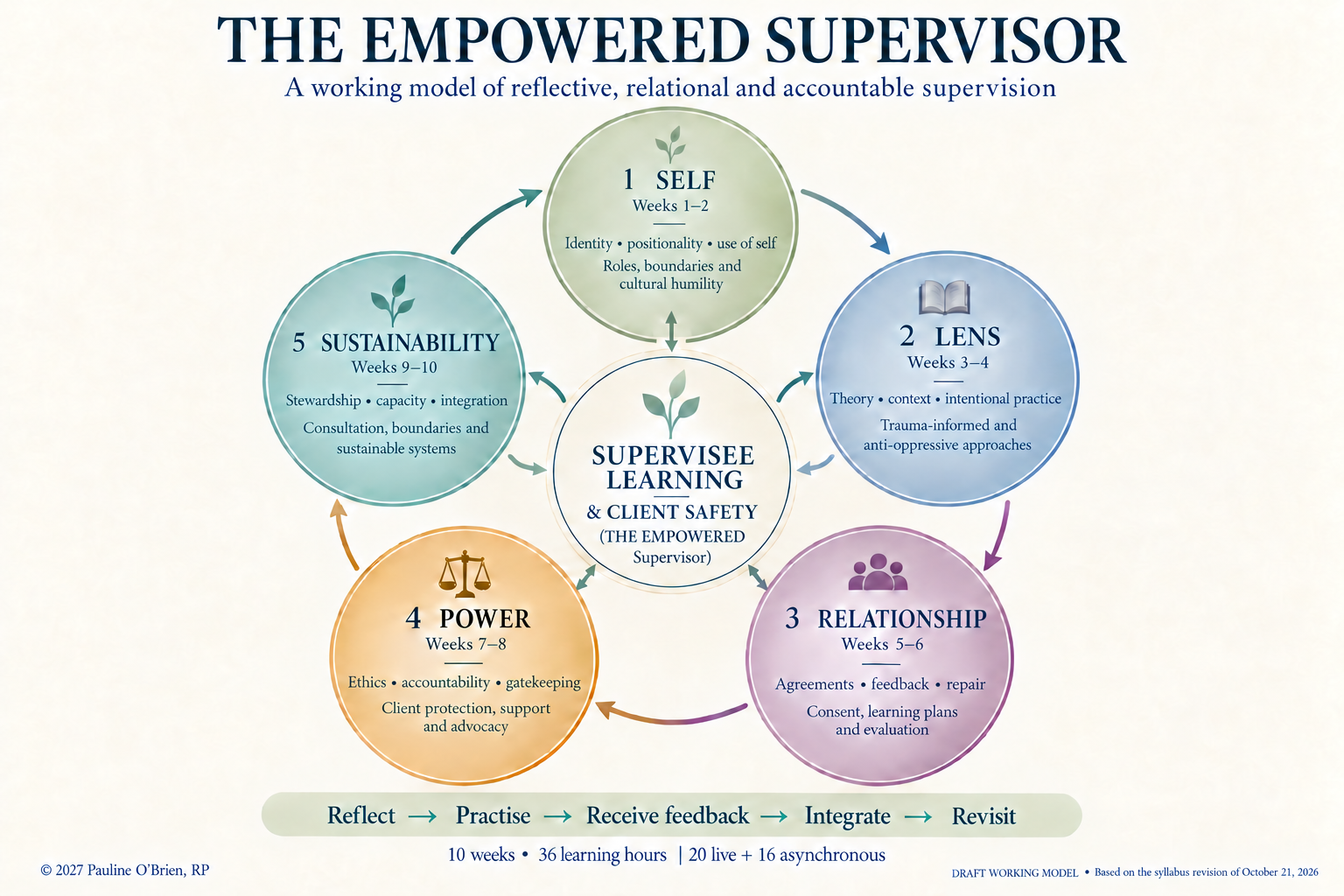
Five connected areas—Self, Lens, Relationship, Power, and Sustainability—support supervisee learning and client safety. Across the ten weeks, reflection, practice, feedback, and integration inform an ongoing cycle of development.
I’d love to welcome you back. I’m developing The Empowered Supervisor: Advanced Practice & Consultation for colleagues who have completed the foundational course.
My intention is to create a small, collaborative space where I can support you in working through the more complex aspects of being a supervisor. I want to make room for difficult conversations, moments of uncertainty, and the ongoing work of holding compassion and accountability together.
Prerequisite: Completion of The Empowered Supervisor foundational course.
This offering is in development. Dates and the final format will be confirmed after reviewing expressions of interest.
I’ll continue to centre supervisee learning and client safety.
I’ve put together a short alumni interest form where you can share your learning priorities, preferred days and times, and anything else you’d like me to know. I’d appreciate your feedback as I develop the offering.
Completing the form is an expression of interest, not registration, and does not commit you to payment. Please do not include identifying client or supervisee information.
Express your interest ↗Three focused courses connecting supervision with power, identity, and access. Designed for practising supervisors and counsellors preparing for supervisory roles, each course brings your learning into conversation with real practice.
Proposed format for each course: four weekly three-hour sessions, totalling 12 hours. Teaching, case discussion, and reflective exercises are grounded in a trauma focused, anti-oppressive approach. Dates, fees, and registration details will be confirmed for upcoming offerings.
Power, relationship, and accountability
Explore how feminist perspectives can inform collaborative, socially responsive supervision. Examine authority, intersectionality, emotional labour, and the ways structural inequities enter supervisory relationships.
Feminist, intersectional, Black feminist, and decolonial perspectives; locating ourselves within supervision.
Authority, collaboration, boundaries, transparency, and the limits of shared power within evaluative relationships.
Recognizing bias, navigating disagreement, and addressing relational ruptures with accountability.
Applying learning to case discussions and developing a feminist supervision philosophy.
A supervision philosophy and practical strategies for discussing power, giving feedback, and supporting equitable learning.
Identity, possibility, and belonging
Explore supervision through queer and trans affirming perspectives. Examine how assumptions about identity, relationships, bodies, and professionalism shape supervision, and practise creating more affirming learning relationships.
Queer theory, heteronormativity, cisnormativity, and assumptions about professional identity.
Coming out, privacy, intersectionality, and a supervisee’s right to choose what they share.
Responding to misgendering, microaggressions, bias, and relational ruptures without placing the burden of education on marginalized supervisees.
Reviewing agreements, case discussions, feedback, and evaluation through a queer affirming lens.
An affirming supervision agreement checklist and a plan for responding to bias within supervisory relationships.
Access, difference, and meaningful learning
Develop supervision practices that recognize neurological differences and support accessible learning. Examine communication, sensory needs, executive functioning, and evaluation while maintaining clear ethical and clinical expectations.
Neurodiversity perspectives, ableism, and varied experiences of autism, ADHD, and other neurological differences.
Collaborative agendas, processing time, sensory access, written feedback, and flexible participation.
Distinguishing communication preferences from competence; making expectations explicit and discussing support without requiring diagnostic disclosure.
Exploring masking, overload, capacity, and individualized approaches through case discussion.
An accessibility conversation guide and a supervision plan tailored to learning preferences and professional responsibilities.
Participants use de-identified examples and develop practical tools to apply in supervision.
Clinical work can be complex, deeply meaningful, and demanding. Supervision offers a dedicated space to think together about your work and the practitioner you are becoming.
Discuss your supervision needs ↗Explore your questions about therapeutic relationships, clinical decisions, and the responses that arise in your work.
Consider context, assumptions, boundaries, and systemic influences through an anti-oppressive lens.
Connect professional development with your capacity, values, and wellbeing as a helping professional.
Connect to discuss fit, current availability, session format, fees, and any supervision requirements relevant to your practice.
Pauline O’Brien, RP, CCC-S · she/they
I’m a psychotherapist, clinical supervisor, educator, and researcher. I created this space to support supervision practices that are compassionate, ethical, inclusive, and sustainable.
More about Pauline →Where am I feeling stuck? What assumptions am I bringing? How might power, identity, or context shape this relationship? What support do I need to practise well?
Explore clinical supervision →Explore the five course modules, from defining supervision and selecting an approach to ethics, resilience, and sustainable practice.
Explore the course modules →Interested in the course or clinical supervision? Visit Pauline’s practice website to connect and ask about current offerings.
Connect to Pauline O’Brien, RP ↗Connect through Pauline O’Brien, RP’s practice website and mention the foundational course, Advanced Practice & Consultation, or the special-topic course that interests you. Ask about the next offering, delivery format, registration, and fees.
Connect to share your professional context and what you are looking for. You can discuss fit, availability, fees, and the requirements that apply to your practice before arranging supervision.
Check directly with your regulator or professional association about the education and supervision requirements relevant to you. You can also ask Pauline about the course content and supervision arrangements.